
Physical Therapist vs Athletic Trainer: Which One Do You Actually Need?
A 15-year-old soccer player walked into my clinic cleared for full participation by her surgeon and her physical therapist. Her knee looked great. Full range of motion, no swelling, a perfect score on her knee function questionnaire.
Then we tested her. Her surgical leg could do 12 single-leg sit-to-stands. Her other leg did 29.
Cleared isn't the same as ready. That gap is the real answer to the question I get asked all the time: do I need a physical therapist or an athletic trainer?
The short answer
If you want to get back to daily life, work, and walking without pain, a good physical therapist is a great fit. If you need to get back to cutting, jumping, sprinting, throwing, or competing at a high level, you need someone who specializes in return to sport. That's where athletic trainers live.
And a lot of the time, the best answer is both.
6 feet across vs. 12 feet deep
Here's how I explain it. An athletic trainer has about 6 feet of depth across the entire injury process:
Prevention before anything happens
Emergency management and on-field care when it does
Acute care at the time of injury and through the first 72 hours
Rehab
Return to sport, which is where we go really deep
Maintenance, circling back to prevention so you don't get hurt again
Courtside with the medical team at a pro beach volleyball (AVP) event. Emergency care and event coverage are part of the athletic trainer's job, too.
A physical therapist has about 12 feet of depth in one section: rehab. Some PTs are strong in return to sport, but in my experience they're few and far between.
When I say return to sport, I don't mean getting back to baseline and daily activities. I mean getting back to a higher level of activity than that. It means understanding exactly what your sport, position, or job demands, and building you back to those demands.
That depth goes both ways. In a traditional setting, an athletic trainer might rehab fewer than 5 ACLs in a year. A physical therapist might see 10 to 20. More reps means a PT is more likely to have seen a rare complication and know how to work through it. That's exactly why the best athletic trainers build a strong network to bounce ideas off.
One more thing: "athlete" is a broad word. When I worked with an orthopedic surgeon, sports medicine covered a lot more than athletes. It included people trying to get back to work, and workers' comp cases often fell under the sports medicine structure. If your job is physical, you're an athlete in my book.
Case study: cleared, but not ready
Back to that soccer player. She was a 15-year-old midfielder, three months out from a small arthroscopic knee procedure. Nothing crazy. Her doctor and PT had both cleared her for full participation.
Thankfully, I had a connection with her doctor, and she knew she wanted more. She was aiming to play in college. So she came to me before jumping back in.
Jump and landing testing shows what a quick visual check can miss.
At a glance, her legs looked symmetrical. Once we got into the nitty-gritty of strength and jump testing, her surgical leg was significantly behind. Research generally looks for 90% to 95% symmetry between legs before a full return to sport.
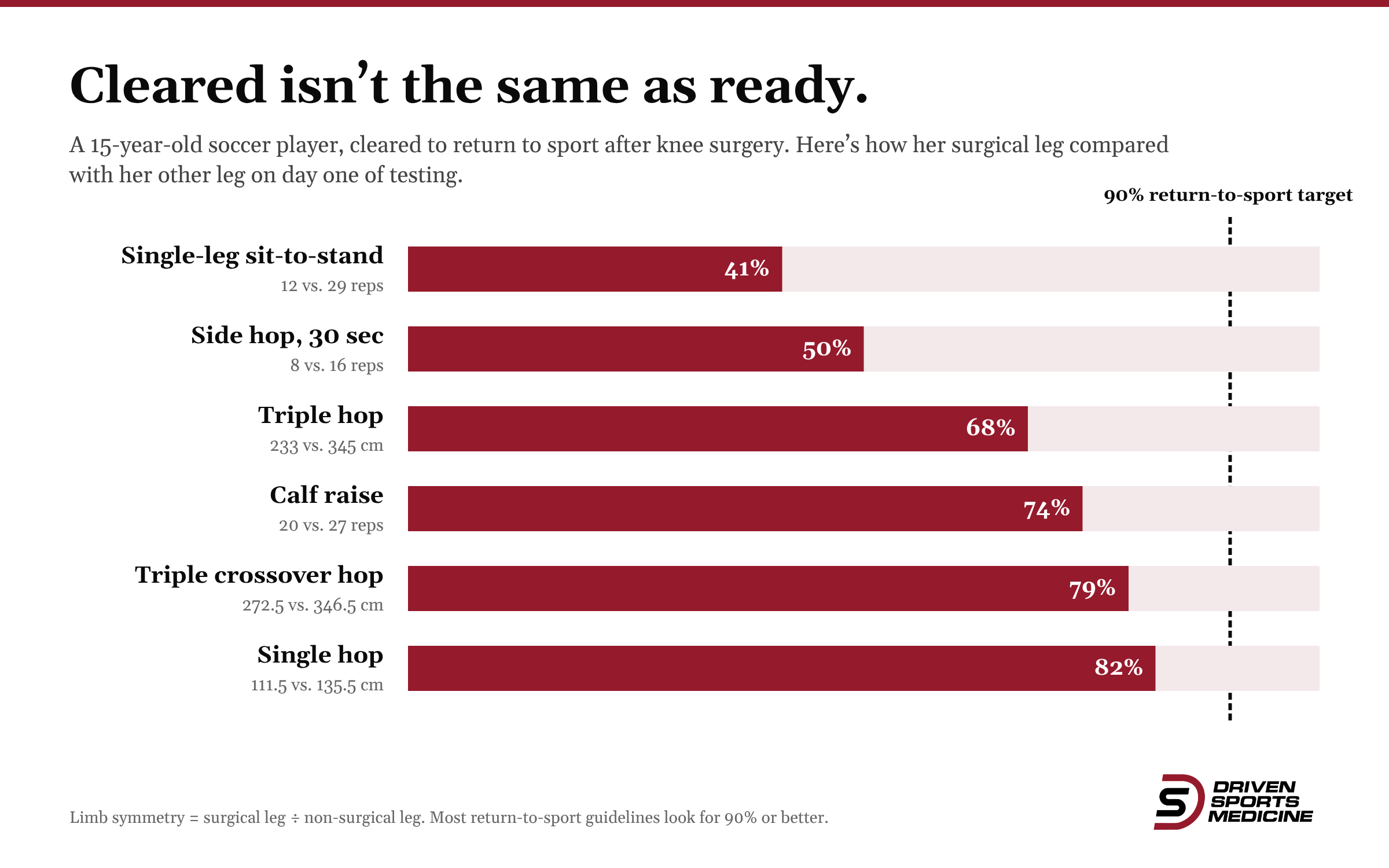
She also had knees caving in on single-leg squats on both sides, and her mile time had gone from 6:30 before the injury to 9:15.
She wasn't broken. She was just unfinished.
We got to work. I started seeing changes within the first four weeks. She adapted fast, got stronger, and showed up ready to work every single time. That's a total testament to her.
When she returned to sport, her parents told me she was a whole new player. Back stronger than before the injury. Cutting faster, making moves faster, and looking more confident on the pitch.
Why the gap exists: insurance, time, and testing
This isn't about PTs doing a bad job. It's about the system many of them work in.
Return-to-sport and return-to-work testing usually isn't paid for by insurance. So a PT working under the insurance model is often limited to one or two tests before clearing someone. I book up to 120 minutes for an evaluation so I can run the full battery.
The reimbursement side is rough too. A physical therapist once told me about an insurance company that paid $17 for an hour-long session. Try running a practice on that. There are some really good sports PTs working hard to run a model like mine. They just have to play the insurance game, and it eats a lot of their bandwidth.
What it costs to work with me
People assume private care is way more expensive. I'm usually right on par with, or a little cheaper than, most physical therapists. Sessions run 45 to 60 minutes and are fully one-on-one. I'm not seeing anyone else during your time.
If you want to use insurance, I'm happy to give you a superbill. You can submit it to try for reimbursement or put it toward your out-of-pocket costs.
What a session with me actually looks like
In a lot of clinics, you go in, do your exercises, and leave. With me, the same person who writes your program is the one running it and doing your hands-on care. We adapt to what you need that day.
Check-in. How are you feeling? Where's the pain, and how bad is it? How have things been since last session? Did you do your homework?
Manual therapy. This is a staple. Depending on what you need, it might be dry needling, cupping, or soft tissue work. The goal is to calm the body down and get you out of pain.
Rehab and strength work. Once you feel better, you get more out of your rehab. We strengthen you in the position we actually want your body to hold.
Manual therapy first: calm the body down so the rehab work lands.
Then strength, in the positions we want the body to hold.
When I send you to a PT
I handle standard sports medicine orthopedics in-house. Here's when I refer out or co-manage with a physical therapist:
You want to use insurance. A PT in network is the better route.
It's outside my experience. Some spinal conditions fall here.
You've had a joint replacement. I've never rehabbed a total knee, hip, or shoulder, so that's outside my lane.
You're not getting better. If we hit a plateau and things aren't changing, I bring in a PT to co-manage or take the lead.
Knowing your scope isn't a weakness. It's part of doing right by the person in front of you.
The best answer is often both
The whole team in one place: athlete, surgeon, athletic trainer, and the people in her corner.
The ideal setup comes down to one thing: open lines of communication. Everyone on the team has access to everyone else. It gets hard when the parent or athlete has to play middleman between providers.
Here's what that looks like in real life. An elite swimmer was coming off shoulder surgery and dropping PT down to once a week. He knew he needed more to get back in the pool. His physical therapist reached out to me directly.
I ran him through my testing, and from there we kept it open and honest. Here's what I'm seeing. Here's what we're doing. Anything you want me to add? We checked in regularly.
The circle went wider than the two of us:
His dietitian got his body composition scans and the guidance I was giving him, and she shared hers with me. The athlete heard one consistent message.
His surgeon got updates on how he was doing. About six weeks in, he had lingering discomfort near one of his posterior surgical portals. We were managing it with manual therapy and still getting through his strength work, but it kept coming back. So I reached out before his follow-up and asked, is this normal?
His surgeon explained it well. During surgery, they try hard not to cut through the posterior shoulder musculature, but sometimes it's unavoidable. That's expected discomfort, not a red flag. One quick conversation, and everyone could keep moving forward with confidence.
The myth: "They played the sport, so they get it"
Just because someone played sports doesn't make them a sports medicine practitioner.
I once talked with a marketer for a big nationwide physical therapy company. Their pitch was that their practitioners played these sports and had an interest in them. That's great. But playing a sport and knowing how to return an athlete to it are two different skill sets.
This applies across the board, doctors included. Your surgeon playing high school football doesn't make him a sports medicine specialist. Where did he go to school? Where did he do his residency and fellowship? Those things matter.
How to vet any provider, AT or PT
Whether you're choosing an athletic trainer, a PT, or a surgeon, ask these questions:
Did they play, and at what level? It's a small piece of the puzzle, but it can point you in a direction. Playing in college gives a different advantage than playing in middle school and high school.
Where did they go to school? You can look up how programs rank. A strong program shows in things like board exam pass rates.
Where did they train after school? Look for residencies, fellowships, graduate assistantships, and internships, especially at high-level programs.
Did they do anything extra? Some providers graduate, start working, and stop there. Others add specializations to better understand their clients' demands. Ask what they did, and whether the education was good.
Years in college athletic training rooms and on college sidelines shaped how I work today.
What that looks like in practice
Here's my path. I did my undergrad in athletic training at Whitworth University in Spokane, Washington. At the time, it was one of the best athletic training programs on the West Coast, with a 100% first-time pass rate on the Board of Certification exam. During school, I worked at the Division I level and with Whitworth's own Division III teams.
I earned my master's through a graduate assistantship, working in that school's athletics department. Then I did an internship at an SEC school, including one of the top swim and dive programs in the country.
Same idea on the physician side. The surgeon I used to work with did his sports medicine fellowship at the Andrews Institute in Gulf Breeze, Florida, one of the premier sports medicine fellowships in the country. That told me right away that he knew how to work a sideline, work with athletic trainers and a team, and handle high-pressure situations.
Surgeons with that kind of training are the ones pro athletes seek out. Dr. Keith Meister, for example, is the head team physician for the Texas Rangers, and players from other MLB teams travel to him for Tommy John surgery. The Steadman Clinic in Vail is another big name. A little research goes a long way.
The bottom line: find someone you trusT
PT or AT, the right choice is someone you trust. Someone who will advocate for you and act as your liaison with the rest of your care team.
I always say, if I don't know the answer, I'll find it. That goes for people too. If you need another resource, provider, or specialist, my job is to get you to the best one.
Trust isn't just a nice feeling. If part of you doesn't trust your provider, your body can tense up and respond poorly to treatment. When you feel calm and understand what's happening, you get more out of your rehab.
So take your time. Don't rush the decision. Surround yourself with people who are looking out for your best interests.
If you or your athlete has been cleared but doesn't feel ready, or you want a return-to-sport plan built around your sport and your schedule, reach out. Message me or visit drivensportsmed.com.
Tori LaBrie, MS, MA, LAT, ATC, is a licensed athletic trainer and the owner of Driven Sports Medicine in Leander, Texas, serving Leander, Liberty Hill, Cedar Park, Georgetown, and surrounding areas.
Sources
